
The Making Of David Bowie (1967)
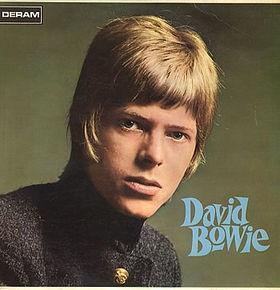
Image: David Bowie World collection / editorial use
Released in the United Kingdom on 1 June 1967, David Bowie was the young artist’s first full-length album and his only original studio album for Deram Records. It introduced a very different Bowie from the one who would later create Ziggy Stardust, Aladdin Sane or the Thin White Duke.
Instead of glam rock or science-fiction drama, the album presented Bowie as a theatrical London songwriter working with music hall, baroque pop, character sketches, comic storytelling and darker lyrical ideas. It was commercially unsuccessful at the time, but it remains an essential starting point in Bowie’s recorded history.
- Album: David Bowie
- Released: 1 June 1967 (UK), 11 August 1967 (US)
- Label: Deram Records
- Recorded: November 1966 – March 1967
- Main studio: Decca Studio 2, West Hampstead, London
- Producer: Mike Vernon
- Engineer: Gus Dudgeon
- Cover photographer: Gerald Fearnley
- Style: Baroque pop, music hall, theatrical pop
- Singles connected to the period: Rubber Band, The Laughing Gnome, Love You Till Tuesday
- Previous album: None
- Next studio album: David Bowie / Space Oddity (1969)
Introduction
David Bowie was not the beginning of David Jones as a performer, but it was the beginning of David Bowie as an album artist.
By 1967 Bowie had already passed through several early groups and record labels. He had been involved with rhythm and blues, mod pop, beat groups and theatrical performance, but he had not yet found the musical identity that would bring him lasting success.
The Deram debut captures Bowie at a very early and uncertain stage. The songs are often playful, eccentric and theatrical, yet many of them already reveal his interest in character, costume, outsiders, social observation and strange narrative perspectives.
For listeners who know Bowie mainly through Hunky Dory, Ziggy Stardust, Low or Heroes, the 1967 album can sound like a different artist. That contrast is exactly what makes it historically important.
Making Of The Album
The album grew out of Bowie’s search for a new direction after his earlier singles had failed to break through commercially.
In the autumn of 1966, after his time with Pye Records came to an end, Bowie recorded new material that helped lead to his deal with Deram, Decca’s progressive pop imprint.
Producer Mike Vernon agreed to work with Bowie, and the sessions for the debut album took place at Decca’s West Hampstead studios. Bowie was still very young, but he was already writing highly visual songs filled with characters, miniature dramas and unusual subject matter.
The result was an album that did not fit neatly into the pop market of 1967. It was not beat music, not psychedelia in the obvious sense, not folk rock, and not conventional singer-songwriter material. Instead, it mixed music hall, cabaret, theatrical pop, orchestral colour and character-based songwriting.
A Young Artist Before The Mythology
The 1967 album is often discussed mainly because it sounds so unlike the Bowie who later became famous.
There is no Ziggy Stardust, no Major Tom, no Aladdin Sane, no Halloween Jack and no Thin White Duke. The voice is already distinctive, but the artistic identity is still forming.
That makes the album valuable as a document of development rather than as a finished statement of the mature Bowie style.
The songs show a young writer trying different masks before he had discovered the larger theatrical systems he would later use so brilliantly.
Finding A Musical Identity
By late 1966 David Bowie had already performed with several groups, including the Konrads, the King Bees, the Manish Boys and the Lower Third. Each project brought him new experience, but none established him as a major recording artist.
Changing his professional name from David Jones to David Bowie solved the confusion with Davy Jones of the Monkees, but a new name alone could not define his musical direction. Bowie was listening to a remarkably wide range of music and refused to limit himself to a single style.
Instead of concentrating solely on rhythm and blues or beat music, he absorbed influences from Anthony Newley, music hall, British baroque pop, folk, theatre and contemporary songwriting. That broad curiosity became one of the defining characteristics of his entire career.
Although these influences did not yet form a completely unified artistic vision, they gave the debut album an originality that set it apart from many British pop records of the period.
From Pye To Deram Records
The path to Bowie’s debut album began after the end of his association with Pye Records during 1966.
Working with bassist Derek “Dek” Fearnley, keyboard player Derek Boyes and drummer John Eager, Bowie recorded demonstration material that attracted the attention of Hugh Mendl, the Artists and Repertoire manager at Decca Records’ newly established Deram label.
Producer Mike Vernon, who was primarily known for blues and rhythm-and-blues recordings, agreed to produce the young songwriter despite recognising that Bowie occupied a very different musical world from most of the artists he normally worked with.
The partnership proved unusual but productive. Vernon concentrated on obtaining the strongest performances possible while allowing Bowie considerable freedom to develop his imaginative arrangements and theatrical songwriting.
Kenneth Pitt‘s Vision
Behind David Bowie’s first album stood the influence of his manager Kenneth Pitt, who believed Bowie possessed the potential to become a sophisticated all-round entertainer rather than simply another rhythm and blues singer.
Pitt encouraged Bowie to develop his songwriting, theatrical presentation and public image. His ambitions extended beyond pop music and included television, theatre and film opportunities, reflecting the broader entertainment careers enjoyed by performers such as Anthony Newley.
Although Bowie would later pursue a far more adventurous artistic path than Pitt originally imagined, the manager’s belief in presentation, professionalism and originality helped shape the period leading to the 1967 album.
Pitt also wrote the original sleeve notes for the album, presenting Bowie as an unusually perceptive young songwriter whose observations extended well beyond ordinary pop lyrics. While the commercial impact of the album was limited, Pitt remained convinced that Bowie possessed exceptional long-term potential.
The Musical Influences
Unlike many British pop albums released during 1967, David Bowie does not follow a single musical style.
Many songs reflect the influence of Anthony Newley and British music hall, while others borrow elements from baroque pop, folk music, light orchestral arrangements and the storytelling traditions of Victorian theatre.
Ray Davies of the Kinks also provided an important example of how ordinary British life could be transformed into vivid character studies. Bowie admired Davies’ ability to create believable fictional personalities, something that became one of his own greatest strengths.
Although psychedelic music was becoming increasingly fashionable during 1967, Bowie largely avoided copying the dominant trends directly. Instead, he created miniature theatrical scenes populated by soldiers, dreamers, lonely children, outsiders, grave diggers and eccentric members of British society.
The Influence Of Anthony Newley
One of the strongest influences on the young David Bowie was British actor, singer and songwriter Anthony Newley. During the mid-1960s Bowie greatly admired Newley’s theatrical vocal delivery, expressive phrasing and ability to combine humour with dramatic storytelling.
That influence can be heard throughout much of the 1967 album. Bowie frequently shifts between spoken passages, exaggerated character voices and carefully articulated melodies, techniques that reflected Newley’s performance style while already revealing Bowie’s own theatrical instincts.
Producer Mike Vernon and engineer Gus Dudgeon later acknowledged the resemblance, although they also recognised Bowie’s originality as a songwriter. Bowie himself would later admit that his early singing style owed a considerable debt to Newley before he gradually developed the more distinctive voice heard from Space Oddity onwards.
Although the influence is unmistakable, it represents an important stage in Bowie’s artistic development rather than simple imitation. Throughout his career he absorbed ideas from admired performers before transforming them into something uniquely his own.
Music Hall
Perhaps the strongest influence on the album was actor, singer and songwriter Anthony Newley.
Bowie openly admired Newley’s dramatic vocal delivery and theatrical storytelling. During the Deram period he occasionally adopted vocal inflections that clearly echoed Newley’s distinctive performance style.
Years later Bowie spoke honestly about this period, acknowledging that the influence had been very strong while also recognising that he had not yet discovered his own mature singing voice.
Rather than viewing this as imitation alone, it is better understood as part of Bowie’s artistic education. Throughout his career he learned by absorbing influences before transforming them into something uniquely his own.
Recording Sessions
The recording sessions for David Bowie took place between November 1966 and March 1967 at Decca Studio 2 in West Hampstead, London.
Producer Mike Vernon supervised the project, while engineer Gus Dudgeon was responsible for recording the sessions. Although both men came largely from rhythm and blues backgrounds, they embraced Bowie’s unusual material and helped shape an album unlike anything else being released by Deram at the time.
Rather than recording the entire album in one continuous block, the sessions were spread across several months. Songs were recorded, revised, orchestrated and mixed as Bowie’s writing continued to develop.
Additional orchestral overdubs, special instrumental parts and final mixes were completed during early 1967 before the finished master was delivered to Deram Records.
The Recording Dates
The album was built over a series of carefully planned studio sessions.
- 14 November 1966: first album session
- 24 November 1966: second recording session
- 8–9 December 1966: further basic recordings
- 12–13 December 1966: additional tracks completed
- 25 February 1967: orchestral recordings and new versions including Rubber Band, Love You Till Tuesday and When I Live My Dream
- 28 February – 1 March 1967: final mixing and completion of the album
This relatively long production period reflected Bowie’s determination to refine both the arrangements and the theatrical atmosphere of the record rather than simply recording a straightforward pop album.
Decca Studios, West Hampstead
All of the album’s recording sessions took place at Decca Studios, located at 165 Broadhurst Gardens in West Hampstead, London.
Bowie worked primarily in Studio 2, which Decca regularly used for contemporary popular music recordings. The studio provided facilities for both small group performances and later orchestral overdubs, allowing Bowie to experiment with increasingly ambitious arrangements.
Although Decca Studios would later become associated with many important British recordings, Bowie’s debut sessions remain among the earliest examples of his fascination with combining traditional instrumentation and unusual studio ideas.
The relaxed working atmosphere also encouraged Bowie to treat the recording studio as a creative environment rather than simply a place to document live performances — an approach that would become central to his later career.
Mike Vernon
Producer Mike Vernon was already highly respected for his work with British blues artists before taking on Bowie’s debut album.
Although Bowie’s theatrical songwriting was far removed from Vernon’s usual productions, he recognised the young musician’s originality and concentrated on presenting the songs as effectively as possible rather than forcing them into a conventional pop format.
Vernon later recalled that Bowie possessed an unusually large number of original songs and ideas. While he personally came from a blues background, he respected Bowie’s determination to create something different.
The collaboration produced an album whose imaginative arrangements and literary storytelling stood apart from most British pop releases of the period, even if commercial success failed to follow immediately.
Gus Dudgeon
The recording sessions were engineered by Gus Dudgeon, who was still in the early stages of what would become one of Britain’s most distinguished production careers.
Dudgeon quickly developed a good working relationship with Bowie. He appreciated the young songwriter’s imagination and was willing to experiment with unusual sound effects, orchestral textures and spoken-word passages that gave the album its distinctive theatrical atmosphere.
Although Dudgeon was not yet the celebrated producer he would later become, his engineering work helped bring clarity and balance to arrangements that mixed conventional pop instrumentation with brass, woodwind and orchestral overdubs.
Their professional relationship continued beyond the Deram sessions. Two years later Dudgeon engineered Space Oddity, the recording that finally gave Bowie his first major international success.
Arthur Greenslade’s Arrangements
Several of the album’s later recording sessions featured orchestral arrangements by Arthur Greenslade, one of Britain’s most respected arrangers and conductors.
Greenslade’s work can be heard particularly on the re-recorded versions of Rubber Band, Love You Till Tuesday and When I Live My Dream, recorded during the final February 1967 sessions.
Rather than overwhelming Bowie’s songs, the orchestrations reinforced their theatrical character, adding brass, woodwind and string textures that reflected the music hall and baroque pop influences running throughout the album.
These carefully written arrangements also demonstrated Bowie’s growing interest in using the recording studio as a place for musical storytelling rather than simply documenting a live band performance.
Building The Arrangements
Unlike many young singer-songwriters making their debut albums during the mid-1960s, Bowie paid close attention to the structure and arrangement of every composition.
Working closely with bassist Derek “Dek” Fearnley, he studied basic music theory in preparation for the recording sessions so they could communicate more effectively with experienced session musicians and orchestral players.
Many of the instrumental parts were added after the basic rhythm tracks had been recorded. Brass, woodwind, strings and unusual solo instruments were carefully overdubbed where Bowie and the production team felt they strengthened each individual song.
Although the finished album often sounds playful and spontaneous, considerable planning went into its arrangements. Even at the age of nineteen, Bowie was already treating records as carefully constructed works rather than simple collections of songs.
An Album Built Song By Song
The production method used for David Bowie differed from the approach adopted by many contemporary beat groups.
Instead of recording the album quickly with a fixed performing band, Bowie and the production team developed the material gradually. Songs were refined over several sessions, arrangements evolved and additional musicians were brought in whenever a particular composition required a different musical colour.
This flexible approach allowed each track to develop its own character. Some songs leaned towards music hall, others towards folk or baroque pop, while several contained surprisingly dark lyrical themes beneath their outwardly cheerful musical settings.
Although Bowie would later become famous for constantly reinventing his musical style from album to album, that willingness to experiment was already visible throughout his very first LP.
Key Musicians
Although David Bowie was presented as a solo album, the recordings relied on a combination of Bowie’s own band members and experienced London session musicians. Rather than using a fixed studio group throughout, producer Mike Vernon selected additional musicians whenever individual songs required specialised instrumentation.
- David Bowie: lead vocals, handclaps
- Derek “Dek” Fearnley: bass guitar, backing vocals, arrangement assistance
- Derek Boyes: piano, organ
- John Eager: drums, backing vocals
- John Renbourn: acoustic guitar (featured on Come And Buy My Toys)
- Big Jim Sullivan: guitar and sitar
- Marion Constable: backing vocals
- Arthur Greenslade: orchestral arrangements
- London Philharmonic Orchestra musicians: orchestral performances on selected tracks
- Mike Vernon: producer, spoken voice on Please Mr Gravedigger
- Gus Dudgeon: engineer, spoken voice and sound effects on Please Mr Gravedigger
David Bowie
At nineteen years of age, Bowie was already the creative driving force behind the project. He wrote every song on the album and worked closely with producer Mike Vernon on arrangements, sequencing and the overall theatrical direction of the record.
Although his instrumental contribution was relatively modest compared with later albums, his vocal performances demonstrated impressive versatility. Throughout the record he moved between character voices, theatrical narration, sentimental ballad singing and more dramatic performances.
Rather than presenting himself as a conventional pop vocalist, Bowie approached many songs almost as miniature stage productions, giving each central character a distinct personality.
This fascination with performance and identity would become one of the defining features of his entire career.
Derek “Dek” Fearnley
Bass player Derek “Dek” Fearnley was one of Bowie’s closest musical collaborators during the Deram period.
Beyond performing on the recordings, Fearnley helped Bowie prepare arrangements before the sessions began. Together they studied basic music theory so they could communicate effectively with orchestral musicians and discuss more ambitious musical ideas.
Fearnley’s contribution extended beyond bass playing. His understanding of arrangement helped translate Bowie’s increasingly imaginative compositions into practical studio performances.
Although later overshadowed by Bowie’s better-known collaborators, Fearnley played an important role in the creation of the singer’s first full-length album.
John Renbourn
Acclaimed guitarist John Renbourn, already respected through his work in the British folk scene and later with Pentangle, contributed acoustic guitar to Come And Buy My Toys.
His sensitive playing brought a genuine folk character to the recording and demonstrated Bowie’s willingness to work with musicians from outside the conventional pop world.
The collaboration also hinted at Bowie’s growing interest in combining different musical traditions, something that would become increasingly important during his later career.
Big Jim Sullivan
One of the most experienced musicians to appear on David Bowie was session guitarist Big Jim Sullivan.
By the mid-1960s Sullivan had already played on hundreds of British recordings and was regarded as one of London’s leading session guitarists. His versatility made him an ideal choice for Bowie’s increasingly imaginative arrangements.
On the album he contributed both guitar and sitar, most notably on Join The Gang, where the Indian-inspired textures reflected the growing fascination with Eastern sounds that had entered British popular music during 1966 and 1967.
His playing added colour without dominating the arrangements, allowing Bowie’s songs to remain the clear focus of the recordings.
Derek Boyes And John Eager
Keyboard player Derek Boyes and drummer John Eager, both members of Bowie’s contemporary live group, formed part of the core musicians during the sessions.
Boyes contributed piano and organ, providing much of the harmonic foundation for the album’s theatrical arrangements. His keyboard parts supported everything from whimsical music-hall numbers to more reflective ballads.
Eager supplied the drum parts while also contributing backing vocals on selected recordings. His solid, understated playing allowed the often elaborate arrangements to develop naturally without overwhelming Bowie’s vocal performances.
Together with Derek “Dek” Fearnley, they provided continuity across sessions that otherwise involved a variety of guest musicians and orchestral performers.
The London Philharmonic Orchestra
Several tracks featured musicians from the London Philharmonic Orchestra, whose performances added richness and sophistication to the album’s arrangements.
Rather than using a full orchestra throughout, individual orchestral musicians were brought in to perform carefully written brass, string and woodwind passages where required.
This approach reflected the production methods used by many ambitious British recordings of the period, allowing Bowie to combine pop songs with more elaborate orchestral textures.
Although modest compared with the large-scale productions of later Bowie albums, these arrangements already demonstrated his interest in expanding beyond the standard rock-band format.
A Remarkably Ambitious Debut
Looking back, one of the most striking aspects of David Bowie is its ambition.
Although the album was not a commercial success, Bowie attempted far more than simply producing a collection of straightforward pop songs. Character studies, theatrical storytelling, orchestral arrangements, unusual instrumentation and literary themes all appeared on his very first LP.
Some ideas were more successful than others, but the album clearly revealed a young artist unwilling to follow established formulas. Even before finding his mature musical identity, Bowie was already determined to experiment.
Many of the themes explored here — identity, performance, social outsiders, surreal humour and dramatic storytelling — would remain central to his work for the next five decades.
Track Listing
The fourteen songs on David Bowie reveal an artist exploring multiple musical directions at once. Music hall, baroque pop, folk, theatrical storytelling and early psychedelic influences all appear throughout the album, while many of the lyrics already hint at themes Bowie would revisit throughout his career.
- Uncle Arthur
- Sell Me A Coat
- Rubber Band
- Love You Till Tuesday
- There Is A Happy Land
- We Are Hungry Men
- When I Live My Dream
- Little Bombardier
- Silly Boy Blue
- Come And Buy My Toys
- Join The Gang
- She’s Got Medals
- Maid Of Bond Street
- Please Mr Gravedigger
Taken together, these fourteen songs document David Bowie before he became an international star. Although stylistically very different from his later work, the album already displays his fascination with storytelling, theatrical performance, unusual characters and musical experimentation.
Important Songs
Although the album was not a commercial success on its original release, several songs have become increasingly appreciated as listeners have revisited Bowie’s earliest recordings. Some reveal the influence of British music hall, while others contain lyrical ideas that foreshadow subjects Bowie would continue exploring during the following decades.
Important Song: Rubber Band
Rubber Band became one of the best-known songs from Bowie’s Deram period and was released as a single in a different recording before the album appeared.
The album version features Arthur Greenslade’s brass arrangement, giving the song a strong music hall atmosphere inspired by Edwardian popular entertainment.
Lyrically, the song tells the story of a former military bandsman remembering his youthful days, combining nostalgia with theatrical storytelling. It demonstrated Bowie’s growing confidence as a writer of character-based songs rather than conventional love lyrics.
Although it failed to become a hit, Rubber Band remains one of the defining recordings from Bowie’s first album.
Important Song: Love You Till Tuesday
One of the album’s most accessible compositions, Love You Till Tuesday blends cheerful pop with playful orchestral arrangements and theatrical humour.
The song was later re-recorded and released as a single in July 1967. Although it also failed to chart, it became closely associated with Bowie’s Deram years and later gave its name to the 1969 promotional film Love You Till Tuesday.
Its bright melody contrasts with the more experimental material elsewhere on the album, illustrating Bowie’s willingness to write straightforward pop alongside more unusual compositions.
Important Song: There Is A Happy Land
Inspired by the games Bowie observed children playing near his childhood home in Bromley, There Is A Happy Land presents childhood as a private world from which adults are excluded.
Musically the song is gentle and folk-influenced, but its lyrics are more thoughtful than they first appear. Rather than simply celebrating innocence, Bowie explores the imagination, secrecy and social structure of childhood.
Many writers have noted that the observational style of the lyrics anticipates Bowie’s later ability to create believable fictional worlds through song.
Although understated, There Is A Happy Land remains one of the album’s most distinctive compositions.
Important Song: We Are Hungry Men
Among the album’s most unusual recordings, We Are Hungry Men combines dark humour with themes of overpopulation, authoritarian leadership and social control.
The song is narrated by a self-appointed saviour whose increasingly disturbing proposals become more extreme as the performance develops. Beneath its theatrical presentation lies one of Bowie’s earliest explorations of power, manipulation and dystopian ideas.
Although presented with irony, the song demonstrates that Bowie was already writing about subjects far removed from conventional pop music.
Many of the themes explored here would later reappear in albums such as The Rise and Fall of Ziggy Stardust and the Spiders from Mars, Diamond Dogs and Outside.
Important Song: Silly Boy Blue
Silly Boy Blue reflects Bowie’s growing fascination with Tibetan Buddhism, a subject that interested him deeply during the mid-1960s.
Rather than attempting an authentic representation of Tibetan music, Bowie created an atmospheric composition inspired by Buddhist imagery and spiritual themes.
The song’s reflective mood differs noticeably from the more theatrical material elsewhere on the album and offers an early indication of Bowie’s willingness to explore philosophical and religious ideas in his songwriting.
Although rarely performed during his later career, Silly Boy Blue remains one of the most personal recordings from the Deram period.
Important Song: She’s Got Medals
One of the album’s most forward-looking songs, She’s Got Medals tells the story of a young woman who disguises herself as a man in order to pursue a military career.
The song is presented with humour, yet it also demonstrates Bowie’s early interest in gender identity, performance and social expectations—subjects that would become increasingly significant throughout the following decade.
Although written within the framework of a comic narrative, the lyrics reveal Bowie questioning traditional ideas about identity long before these themes became central to his public image.
In retrospect, She’s Got Medals stands as one of the album’s most historically interesting compositions.
Important Song: Please Mr Gravedigger
The album concludes with Please Mr Gravedigger, one of the most experimental recordings Bowie had yet attempted.
Performed almost entirely as a spoken dramatic monologue accompanied by sound effects rather than conventional instrumentation, the piece demonstrates Bowie’s growing fascination with theatre and character performance.
Rain, footsteps and coughing create an unsettling atmosphere while Bowie delivers the text as though performing a miniature stage play rather than a pop song.
Although unusual for a debut album, Please Mr Gravedigger revealed Bowie’s willingness to ignore commercial expectations in favour of dramatic storytelling and experimentation.
Singles From The Album
Although the album itself was not commercially successful, several singles were released during the Deram period to promote David Bowie as a new recording artist. Some appeared before the album, while others followed its release. Together they document Bowie’s rapid musical development during 1966 and 1967.
Rubber Band
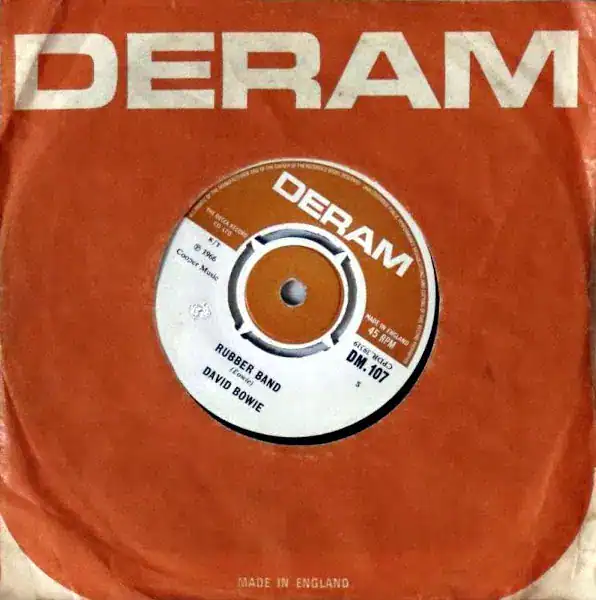
Released in December 1966, Rubber Band became Bowie’s first single for Deram Records.
The single version was not identical to the recording that later appeared on the album. For the LP, the song was re-recorded with Arthur Greenslade’s more elaborate brass arrangement, giving it an even stronger Edwardian music-hall character.
Although it failed to chart, Rubber Band remains one of the defining recordings from Bowie’s first recording contract with Deram and demonstrates his early fascination with theatrical storytelling.
The Laughing Gnome
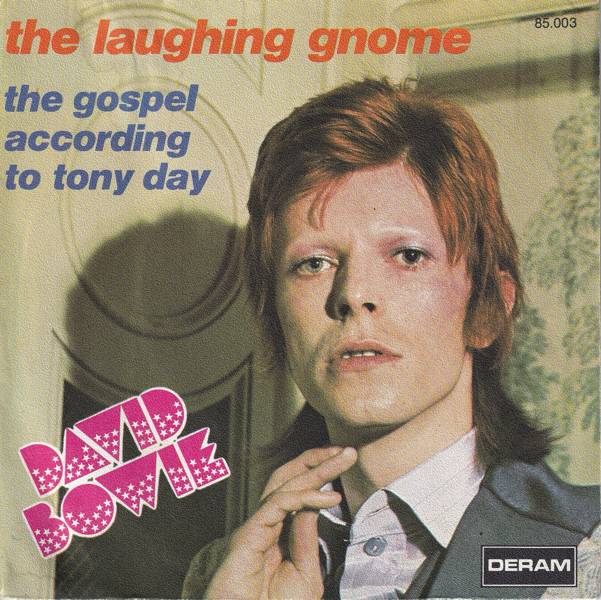
Released in April 1967, The Laughing Gnome became Bowie’s second Deram single.
Although the song was not included on the David Bowie album, it belongs to the same recording period and reflects the whimsical humour that characterised much of his early work.
The recording made extensive use of sped-up vocals to create conversations between Bowie and the gnome, illustrating his willingness to experiment with studio techniques long before his breakthrough years.
Initially the single attracted little attention, although it later became famous because of Bowie’s subsequent success.
Love You Till Tuesday
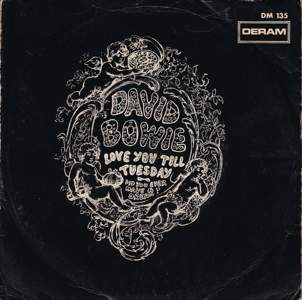
Following the album’s release, Deram issued Love You Till Tuesday as a single in July 1967.
Despite its catchy melody and optimistic arrangement, the record failed to become the commercial breakthrough Bowie and the label had hoped for.
The song nevertheless remained important in Bowie’s history. Two years later it became the title of the promotional film Love You Till Tuesday, produced to introduce his earlier work to prospective record companies after he had left Deram.
No Later Single Releases
Unlike many of Bowie’s later albums, David Bowie does not require a separate “Later Single Releases” section. The singles associated with the album all belong to the original Deram period of 1966 and 1967.
Making Of The Album Cover
Although the music on David Bowie revealed a young songwriter still searching for his artistic identity, the album sleeve presented a carefully controlled public image. Released in 1967 by Deram Records, it introduced David Bowie under his new professional name and established the visual starting point of a career that would later become famous for constant reinvention.
Unlike the highly conceptual artwork of Bowie’s 1970s albums, the debut sleeve was deliberately straightforward. There were no elaborate characters, futuristic settings or theatrical costumes. Instead, the emphasis was placed entirely on Bowie himself, presented as a fashionable young London musician at the beginning of his recording career.
The portrait is simple, direct and highly representative of London’s mid-1960s fashion. Rather than creating a fictional character, it introduces David Bowie as an ambitious young singer-songwriter whose appearance reflected contemporary mod style and theatrical sophistication.
Looking back today, the image is fascinating because it shows Bowie before any of the visual transformations that later defined his career.
Want to discover the full story behind the album cover? Explore the complete history of its design, photography, artwork and production.
Gerald Fearnley’s Photograph
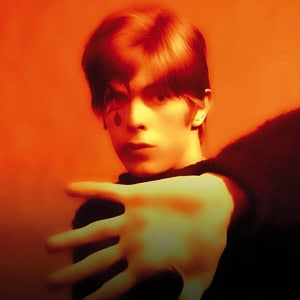
The cover photograph was taken in Gerald Fearnley’s photography studio, located beneath a church in Bryanston Street near Marble Arch in central London.
Fearnley later recalled that he already knew Bowie through his brother Derek and simply happened to be one of the few photographers available with both a professional studio and suitable equipment.
The resulting portrait is remarkably restrained. Bowie faces the camera directly, dressed smartly and presented without theatrical props or dramatic effects. The emphasis is entirely on the young artist rather than on visual spectacle.
Although modest compared with the celebrated album covers that followed during the 1970s, the photograph remains historically significant as the first official studio portrait used for a David Bowie album.
The Military Jacket
One of the most recognisable features of the cover is Bowie’s tailored military-style jacket.
Years later Bowie recalled that he had been extremely proud of the garment, describing it as one of the first handmade military-style jackets he owned. It reflected London’s growing interest in Edwardian-inspired fashion and military tailoring during the mid-1960s.
Although the jacket appears relatively understated today, it represents an early example of Bowie’s lifelong fascination with clothing as an extension of artistic identity.
This interest in costume would later evolve into the elaborate visual worlds of Ziggy Stardust, Aladdin Sane, Halloween Jack and many other Bowie personas.
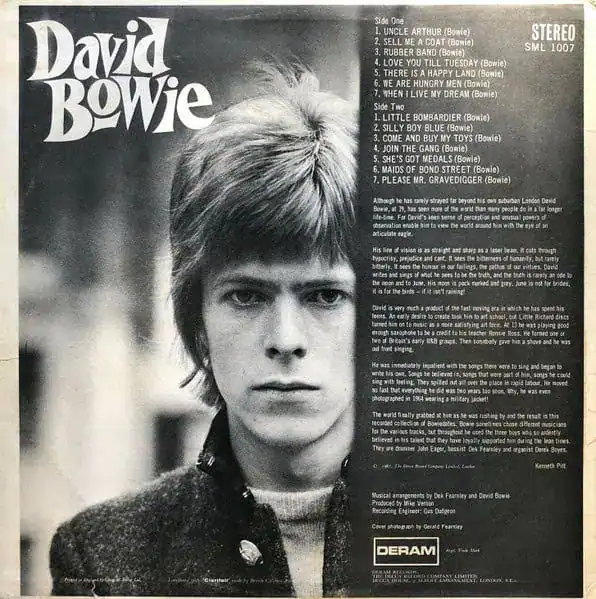
The Original Back Cover
The rear sleeve featured a second portrait of Bowie, photographed by David Wedgbury on the Thames Embankment close to Decca’s London offices.
Unlike the front cover, which served as Bowie’s formal introduction to the public, the back photograph presented a more relaxed image while maintaining the same clean and contemporary visual style.
The sleeve notes were written by Bowie’s manager Kenneth Pitt, who presented the nineteen-year-old singer as an unusually perceptive songwriter with exceptional powers of observation and originality.
Although promotional in tone, the notes reveal the confidence that Pitt already had in Bowie’s creative potential, even before commercial success arrived.
Release And Reception
David Bowie was released in the United Kingdom on 1 June 1967 by Deram Records in both mono and stereo editions. Although the album marked an important milestone in Bowie’s career as his first full-length release under the name David Bowie, it attracted little commercial attention at the time.
The British music scene of 1967 was changing rapidly. Psychedelia, progressive pop and increasingly ambitious studio productions dominated the charts, while Bowie presented an album rooted in theatrical storytelling, music hall traditions and character-based songwriting. As a result, the record proved difficult to categorise and struggled to find a large audience.
The album was released in the United States on 11 August 1967. The American edition omitted We Are Hungry Men and Maid Of Bond Street, reducing the running order from fourteen to twelve tracks.
Commercially, the album performed modestly and failed to establish Bowie as a major recording artist. Within a year Deram decided not to renew his recording contract, leaving Bowie once again searching for a new musical direction.
Mono And Stereo Editions
When David Bowie was released in June 1967, Deram Records issued the album in both mono and stereo editions. At the time many British listeners still owned mono record players, while stereo was becoming increasingly popular.
Both editions contain the same fourteen songs and were completed during the final mixing sessions in late February and early March 1967. The differences lie mainly in the balance and placement of voices, instruments and orchestral arrangements rather than in the performances themselves.
The American edition, released in August 1967, differed more significantly by omitting We Are Hungry Men and Maid Of Bond Street, reducing the album to twelve tracks. Consequently, the original UK release remains the complete contemporary version of Bowie’s debut album.
Original mono and stereo pressings are now highly regarded by collectors, while modern reissues have made both mixes widely available for comparison.
Critical Response
Contemporary reviews were generally respectful but unenthusiastic. Critics recognised Bowie’s imagination and originality, yet many were uncertain how to classify his unusual mixture of music hall, theatrical pop and whimsical storytelling.
In hindsight, many observers have concluded that the album simply arrived before Bowie had fully discovered his own artistic identity. While individual songs showed considerable promise, the record lacked the unified musical vision that would characterise his later masterpieces.
Modern opinion has become far more sympathetic. Rather than dismissing the album as an early curiosity, many writers now regard it as an essential document of Bowie’s artistic development.
Its importance lies not in commercial success but in revealing the first stages of ideas that Bowie would continue developing throughout the following decades.
The Beginning Of A New Journey
Although David Bowie failed to make a significant commercial impact, it marked the true beginning of Bowie’s career as a recording artist under the name by which he would become world famous.
Many characteristics that later defined his work already appear throughout the album: theatrical presentation, fascination with unusual characters, literary storytelling, social observation and a willingness to experiment beyond the boundaries of mainstream pop.
The album also demonstrated Bowie’s refusal to accept creative limitations. Even before achieving success, he was prepared to challenge expectations and pursue ideas that differed from prevailing musical fashions.
That determination would become one of the defining qualities of his entire career.
Legacy
Today David Bowie occupies a unique place within Bowie’s catalogue. Although often overshadowed by the extraordinary albums that followed during the 1970s, it remains an indispensable record for understanding how his artistic identity developed.
The debut captures Bowie before Ziggy Stardust, before Major Tom became an international icon and before the continual reinventions that transformed him into one of popular music’s most influential artists.
Its mixture of humour, theatricality, social commentary and musical curiosity reveals a remarkably ambitious young songwriter who was already searching for new ways to combine music, drama and storytelling.
Many of the subjects explored here—including identity, performance, outsiders, authority, spirituality and theatrical narrative—would continue to reappear throughout Bowie’s career in increasingly sophisticated forms.
Article Origin
This page was created using historically documented information relating to the writing, recording, production, release and visual presentation of David Bowie’s 1967 debut album.
The article draws upon documented studio records, interviews with David Bowie, Mike Vernon, Gus Dudgeon and other participants, contemporary Deram Records documentation, release history, archival material and the David Bowie World collection.
The cover artwork section was developed from the existing David Bowie World research into the 1967 album sleeve, including Gerald Fearnley’s photography, David Wedgbury’s back-cover portrait and the original Deram artwork.
