
The Making Of Pin Ups (1973)
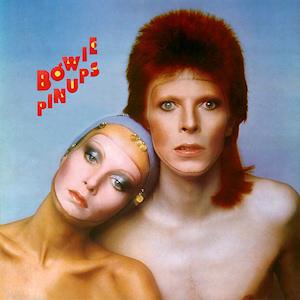
Image: David Bowie World collection / editorial use
Released on 19 October 1973, Pin Ups is often described as David Bowie’s covers album, but that simple description does not fully explain its importance. The album was made immediately after the dramatic end of the Ziggy Stardust era and became a personal tribute to the London music scene that had shaped Bowie as a teenager.
Rather than inventing a new character straight away, Bowie stepped back and revisited the songs, clubs and bands that had inspired him before fame arrived. In that sense, Pin Ups was both a pause and a transition: a look back before the next transformation.
- Album: Pin Ups
- Released: 19 October 1973
- Recorded: July 1973
- Main studio: Château d’Hérouville, France
- Additional work: Trident Studios, London
- Producer: Ken Scott
- Label: RCA Records
- Previous album: Aladdin Sane
- Next album: Diamond Dogs
- Concept: Bowie revisits favourite songs from the London scene of 1964–1967
The End Of Ziggy Stardust
The making of Pin Ups begins only days after one of the most famous moments in David Bowie’s career.
On 3 July 1973, Bowie ended the Ziggy Stardust tour at London’s Hammersmith Odeon. During the concert’s closing moments, he told the audience that it was not only the last show of the tour, but “the last show we’ll ever do”.
The statement shocked fans and created confusion. Bowie was not retiring from music, but he was bringing the Ziggy Stardust character and that version of the Spiders from Mars story to an end.
After more than a year of intense touring, publicity and performance, Bowie needed space to reassess what should come next.
Why Bowie Chose A Covers Album
At first glance, recording a covers album immediately after Ziggy Stardust and Aladdin Sane might seem like an unusual decision.
Bowie had just become one of Britain’s most important new songwriters, yet he chose not to follow those albums with another major original concept straight away.
Instead, he returned to the records that had excited him during his teenage years in London.
The idea was not simply nostalgia. Bowie wanted to reinterpret the songs through the sound and attitude of 1973, using the musicians and production approach that had defined his glam-rock period.
Want to discover the full story behind the Pin Ups cover? Explore the famous photo session with Twiggy, photographer Justin de Villeneuve and the album’s striking visual concept.
The London Scene Of 1964–1967
Pin Ups focused mainly on songs from the British beat, rhythm and blues, mod and psychedelic scenes of the mid-1960s.
The album included material originally associated with The Pretty Things, The Yardbirds, The Who, Pink Floyd, Them, The Easybeats, The Mojos, The Merseys and The Kinks.
These were not random oldies. Many of them came from the period when the young David Jones was watching bands, absorbing stagecraft and learning how British pop music could reinvent itself almost overnight.
Bowie later explained that he was retracing his own musical past: the records he loved, the bands he watched and the London sound that had shaped him before he became famous.
Track Listing
The songs on Pin Ups reflected Bowie’s admiration for the London beat, rhythm and blues and psychedelic scene of the mid-1960s.

Image: David Bowie World collection / editorial use
- Rosalyn (The Pretty Things)
- Here Comes The Night (Them)
- I Wish You Would (The Yardbirds)
- See Emily Play (Pink Floyd)
- Everything’s Alright (The Mojos)
- I Can’t Explain (The Who)
- Friday On My Mind (The Easybeats)
- Sorrow (The Merseys)
- Don’t Bring Me Down (The Pretty Things)
- Shapes Of Things (The Yardbirds)
- Anyway, Anyhow, Anywhere (The Who)
- Where Have All The Good Times Gone! (The Kinks)
Together, these twelve songs formed Bowie’s personal tribute to the artists, clubs and records that shaped his musical tastes during the 1960s.
A Personal Tribute, Not A Simple Stopgap
Because Pin Ups is made entirely of cover versions, it has sometimes been dismissed as a light or temporary project.
That view misses the point. The album was a carefully chosen map of Bowie’s early influences.
Rather than copying the originals respectfully, Bowie and his band rebuilt the songs in the language of early-1970s glam rock.
The result was a kind of pop-art tribute: familiar songs transformed through Bowie’s voice, Mick Ronson’s arrangements and the sharp production style of Ken Scott.
Heading To Château d’Hérouville
On 9 July 1973, only a few days after the final Ziggy concert, Bowie travelled from London to France.
The recording location was Château d’Hérouville, an eighteenth-century château north of Paris that had been converted into a residential recording studio.
The studio was also known as Strawberry Studios and became famous as the place where artists could live, eat and record without leaving the grounds.
Bowie knew the château partly through Marc Bolan, who had recorded there with T. Rex. The location offered both privacy and flexibility at a moment when Bowie needed to work quickly.
The George Sand Studio
Château d’Hérouville contained more than one studio space. Much of Pin Ups was recorded in the George Sand Studio, located in converted stables on the château grounds.
The setting was very different from a conventional London studio. Musicians could rehearse, record, eat and sleep in one place, creating a concentrated but relaxed working environment.
That atmosphere suited the album perfectly. The songs were familiar to many of the musicians, and the sessions moved quickly.
Instead of months of conceptual development, Pin Ups was built around energy, memory and instinct.
The Musicians
Although the Ziggy Stardust era had just ended, much of Bowie’s trusted musical team remained in place for Pin Ups.
Guitarist Mick Ronson, bassist Trevor Bolder, keyboard player Mike Garson, saxophonist Ken Fordham and backing vocalist Geoff MacCormack all contributed to the sessions.
One major change had occurred, however. Drummer Woody Woodmansey, a founding member of the Spiders from Mars, was no longer involved. His place was taken by the experienced Aynsley Dunbar.
Aynsley Dunbar Joins The Sessions
Dunbar brought an impressive musical pedigree to the project. Before joining Bowie, he had already worked with a remarkable range of artists and bands, establishing himself as one of Britain’s most respected rock drummers.
His arrival added a slightly different rhythmic feel to the recordings. While the spirit of the Spiders remained present, Pin Ups also hinted at the changes that would soon reshape Bowie’s musical direction.
Mick Ronson At His Peak
If one musician dominates the sound of Pin Ups, it is Mick Ronson.
His guitar work runs throughout the album, transforming many of the original recordings into powerful glam-rock performances. Ronson was particularly enthusiastic about revisiting songs by The Yardbirds, one of his favourite bands of the 1960s.
Rather than merely copying the originals, he rebuilt them with heavier guitars, richer arrangements and a confidence that reflected years of touring and recording experience.
Many fans consider Pin Ups one of Ronson’s finest studio performances.
Recording The Songs
The sessions moved quickly. Most of the musicians already knew the material and required little time to learn the songs.
Producer Ken Scott later recalled that the atmosphere was unusually relaxed compared with some earlier Bowie projects.
The recordings often began with a run-through before the tape machines were switched on. In many cases the final performances retained the freshness and spontaneity of those early takes.
Work continued throughout July 1973, with sessions frequently lasting twelve hours or more.
The Sound Of Pin Ups
One of the album’s greatest achievements is the balance it strikes between respect and reinvention.
Bowie did not attempt to recreate the songs exactly as they had sounded in the 1960s. Instead, he imagined how they might have sounded if those bands had emerged during the glam-rock era.
As a result, Pin Ups often feels simultaneously nostalgic and modern. The original melodies remain intact, but the production, arrangements and performances firmly belong to 1973.
The First Single: Sorrow
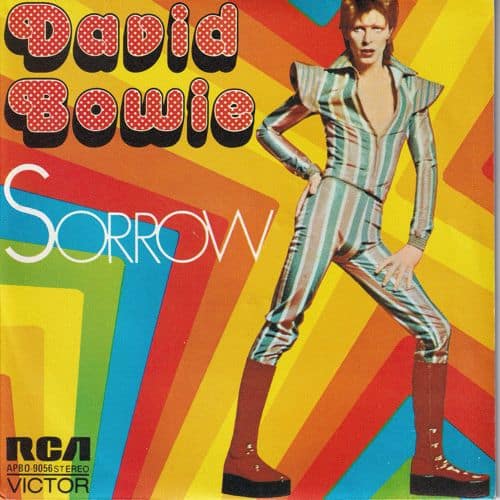
The album’s most successful single was Sorrow, originally associated with The Merseys.
Released shortly before the album, Bowie’s version became a major international hit. It reached number three in the United Kingdom and topped the charts in several countries.
Although some critics later questioned whether it was the strongest song on the album, its commercial success helped establish Pin Ups as much more than a niche tribute project.
The Sunset Strip Billboard Campaign
To promote Pin Ups, Bowie’s management company MainMan launched an ambitious billboard campaign on Los Angeles’ famous Sunset Strip.
The campaign featured several MainMan artists, including David Bowie, Mick Ronson and Mott The Hoople. Large roadside billboards helped establish Bowie’s growing presence in the American market at a time when his popularity was expanding rapidly.
One of the most unusual promotions was linked directly to the Pin Ups artwork. Fans were invited to participate in a competition in which the winning entrant’s face would replace Twiggy’s image on selected billboard advertisements.
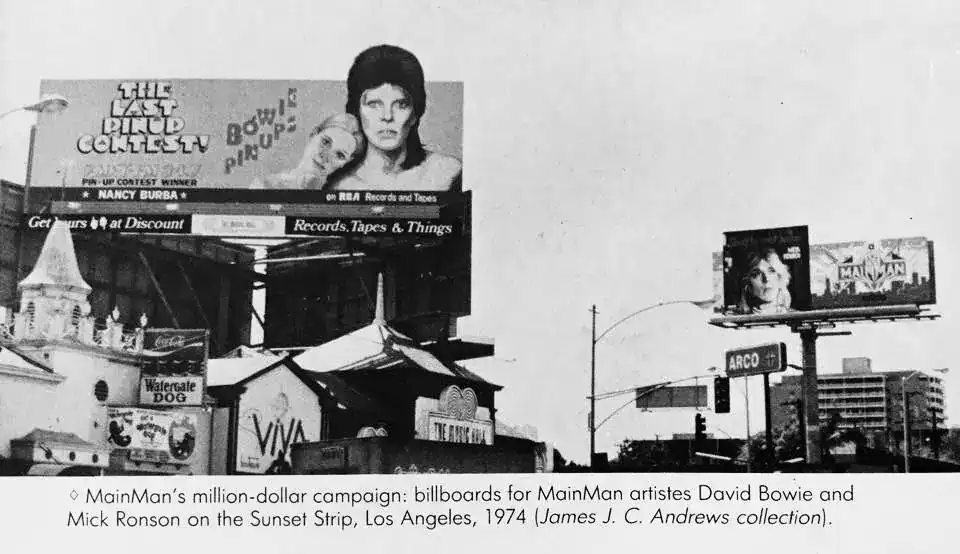
Image: James J. C. Andrews collection / editorial use
The campaign reflected the increasingly sophisticated marketing surrounding Bowie in 1973 and 1974. What had begun only a few years earlier as a cult following was rapidly becoming an international phenomenon.
Today, surviving photographs of these Sunset Strip billboards provide a fascinating glimpse into how Pin Ups was promoted during Bowie’s rise to global stardom.
Promoting Pin Ups Around The World
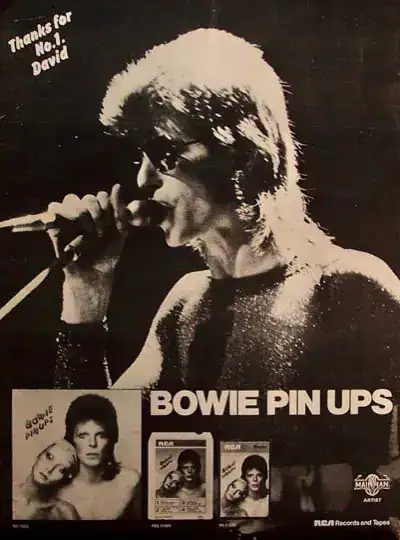
Following the release of Pin Ups, RCA Records and Bowie’s management company MainMan launched an extensive international promotional campaign.
Advertisements appeared in music magazines, record stores and on large outdoor displays, helping to establish Bowie as one of the most visible rock artists of the period.
Promotional material often combined contemporary photographs of Bowie with the distinctive Pin Ups artwork, creating a strong visual identity for the album.
By late 1973 and early 1974, Bowie’s popularity had expanded far beyond the United Kingdom. Campaigns such as these helped introduce Pin Ups to audiences across Europe and North America.
Today, surviving advertisements and promotional displays provide a fascinating glimpse into how Bowie and RCA marketed the album during one of the most successful periods of his career.
The Bryan Ferry Situation
During the summer of 1973, another prominent British artist was considering a similar idea.
Bryan Ferry was preparing what would become These Foolish Things, his own collection of favourite songs.
For a short period, rumours suggested a rivalry between the two camps over who had first conceived the idea of recording an album of cover versions.
In reality, the two projects were very different. Ferry drew material from a broad range of decades and styles, while Bowie focused almost entirely on a specific period of London music history.
The Last Spiders Era Album
Although the Ziggy Stardust character had been retired, Pin Ups effectively became the final studio album created by the classic Bowie–Ronson–Bolder partnership.
Within months, Bowie’s musical world would change dramatically. New influences, new musicians and new artistic ambitions would begin to emerge.
For that reason, the album serves as a farewell not only to the 1960s songs it celebrates, but also to the creative team that helped make Bowie a star.
The Road To Diamond Dogs
While recording Pin Ups, Bowie was already beginning to think about the future.
Ideas inspired by George Orwell’s Nineteen Eighty-Four were taking shape, eventually leading to the creation of Diamond Dogs.
In hindsight, Pin Ups occupies a unique position within Bowie’s catalogue. It looks backwards more than almost any other Bowie album, yet it stands directly before one of his boldest leaps forward.
Reception And Success
Upon release, Pin Ups performed strongly commercially, reaching the top of the UK album chart.
Some critics initially regarded it as a minor release compared with Ziggy Stardust or Aladdin Sane, but many later reassessed the album more favourably.
Its strength lies not in originality of composition, but in Bowie’s ability to reinterpret familiar songs and reveal what had inspired him in the first place.
Legacy
Today, Pin Ups remains one of the most personal albums in David Bowie’s catalogue.
Rather than presenting another fictional character or elaborate concept, the record offers a glimpse into Bowie’s musical upbringing. It reveals the records he admired, the bands he followed and the sounds that helped shape his artistic identity.
Far from being a simple covers album, Pin Ups stands as a carefully crafted tribute to a vanished era of British music and a fascinating bridge between Ziggy Stardust and the ambitious future of Diamond Dogs.
Article Origin
This page was created using historically documented information relating to the recording of Pin Ups, including interviews with David Bowie, Ken Scott, Mick Ronson and contemporary accounts of the Château d’Hérouville sessions.
Additional research was drawn from Bowie archive material, recording-session documentation, period interviews and published studies of Bowie’s 1973 transition from Ziggy Stardust to the next phase of his career.
